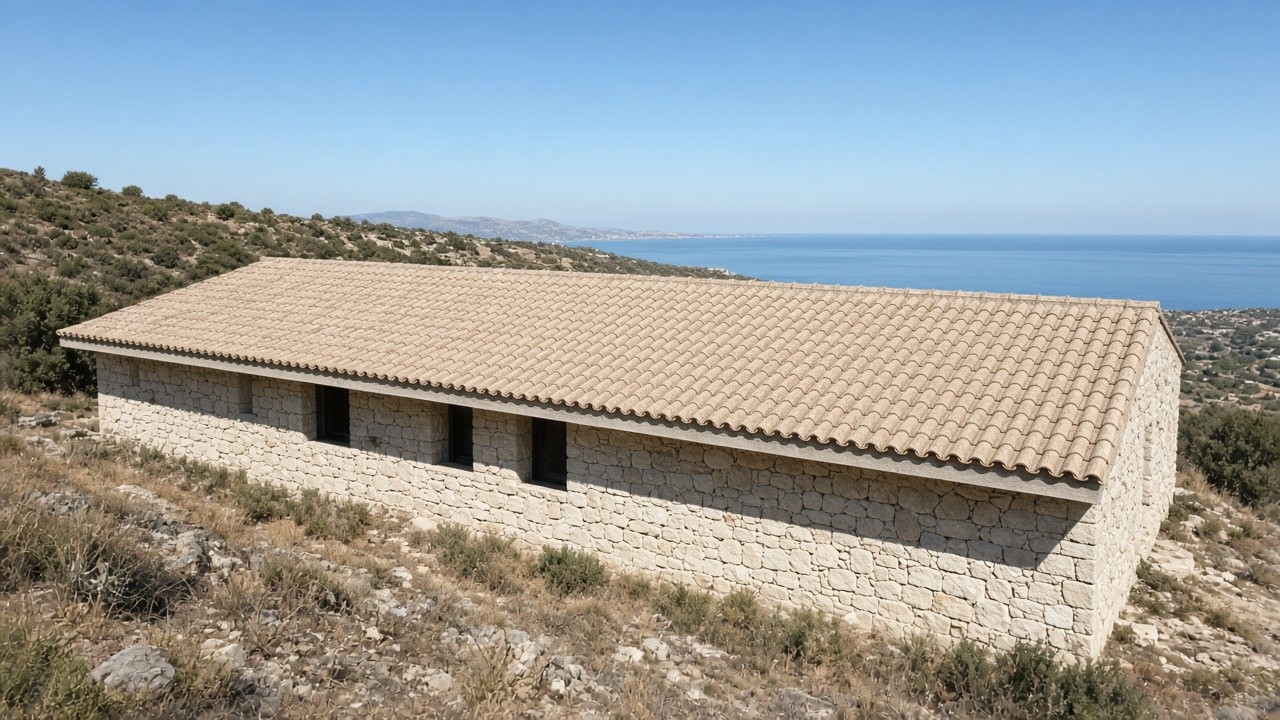
Bodrum, Turkey
Insulating the house
Roof, wall and glass are resolved together.
In August the tiles on a Bodrum roof are too hot to keep a hand on, while the wall is only warm. The heat that matters gathers later, in front of the glass that faces west. People call the remedy insulation and close the job by fixing a board to the wall. The board does not keep the day’s account. The roof takes the sun through the middle of the day. Thick stone gives that heat to the room hours afterwards. Glass hands back, through a single opening, the work spent on the wall. Until the three are thought through together, the house does not cool. The machine runs in the evening. It is still running in the morning.
- Roof
- Air under the tile
- Wall
- Thick stone
- Glass
- The evening sun
- Moisture
- Dry stone
Roof
The tile heats before the wall
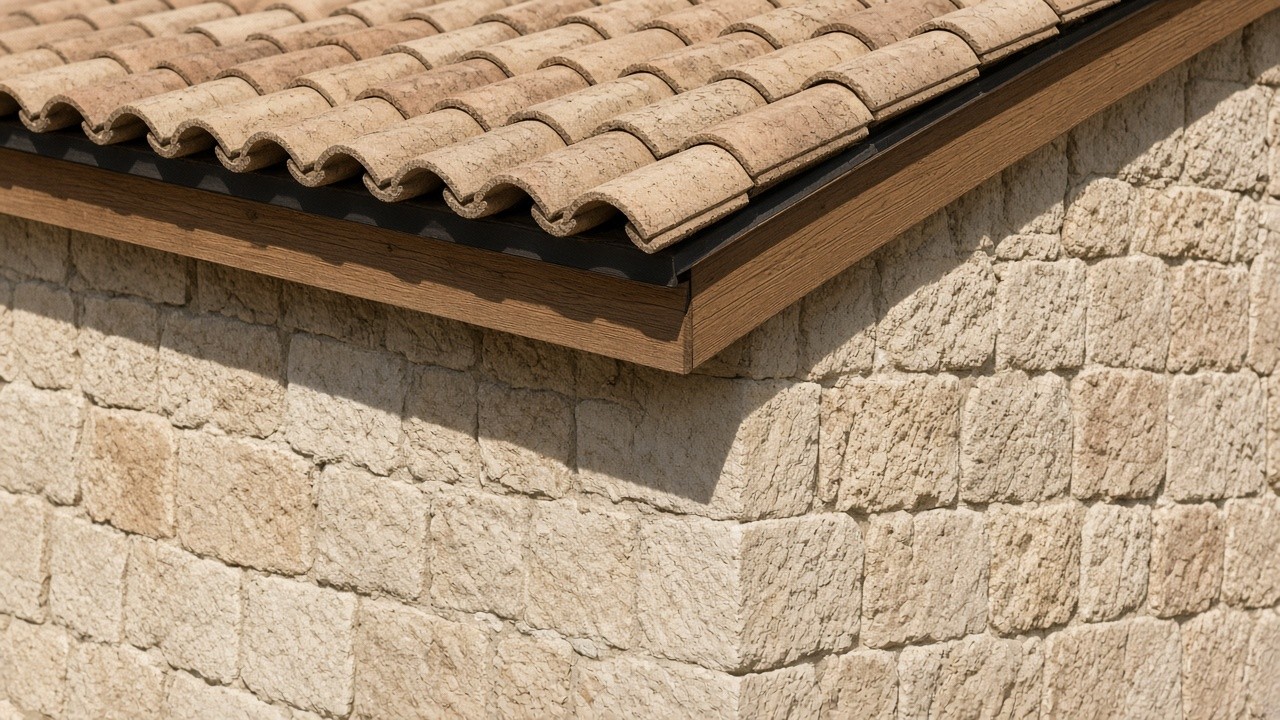
The heat that burns the hand passes into the air under the tiles and keeps moving down toward the slab until evening. In Bodrum the first act of keeping a house cool is to cut that descent, not to wrap the wall. The tile stays light in colour. Beneath it there is a gap where air can move. The insulation spreads under that gap, over the slab, without thinning out at the edge. If the roof is not built this way, the board on the wall does not change the afternoon.
Rain is not left out of this account. The summer is dry, and the water comes in winter. Insulation that has been soaked no longer holds heat. To hope that one material will stop both the water and the sun is to leave the roof open to each of them. The waterproof sheet is above. The insulation is below. Between them is the gap the air moves through.
Wall
Thick stone and a thin facing are not the same wall
Local limestone of about forty centimetres works in another way. It gives the day’s heat to the room slowly. At night, when the shutters are open, air from windows set opposite one another cools that stone, and the stone holds the cool until morning. A board fixed to the inside face ends the exchange. The room is cut off from the stone. From outside the house still looks as if it were built of it. Inside, the coolness of the stone is gone.
If the stone is a facing of about twenty millimetres and the structure behind it is a concrete frame, coolness is not expected of that plate. The weight is not in it. The insulation is outside the frame. It passes the side of the column and the place where the slab meets the wall without a break. The stone stands with a little air in front of it. It meets the rain. It is not asked to hold the heat.
Materials
Roof insulation
It sits under the air gap beneath the tiles, not stuck to the waterproof sheet. Once it is wet it stops holding heat.
Waterproof sheet
It sits above the insulation and is built for the winter rain. A dry summer does not leave this layer for later.
Insulation outside
On a concrete frame it continues past the column and the edge of the slab. It is not fixed to the inside face of thick stone. On that face the stone itself is doing the work.
Insulated glass
It lets less of the sun’s heat indoors. It is considered together with the overhang on the south and a vertical oak shutter on the west.
Lime plaster
Indoors it is brought to ivory. It stands in place of a cement plaster that would stop the stone from drying, because wet stone gives its heat to the room.
Glass
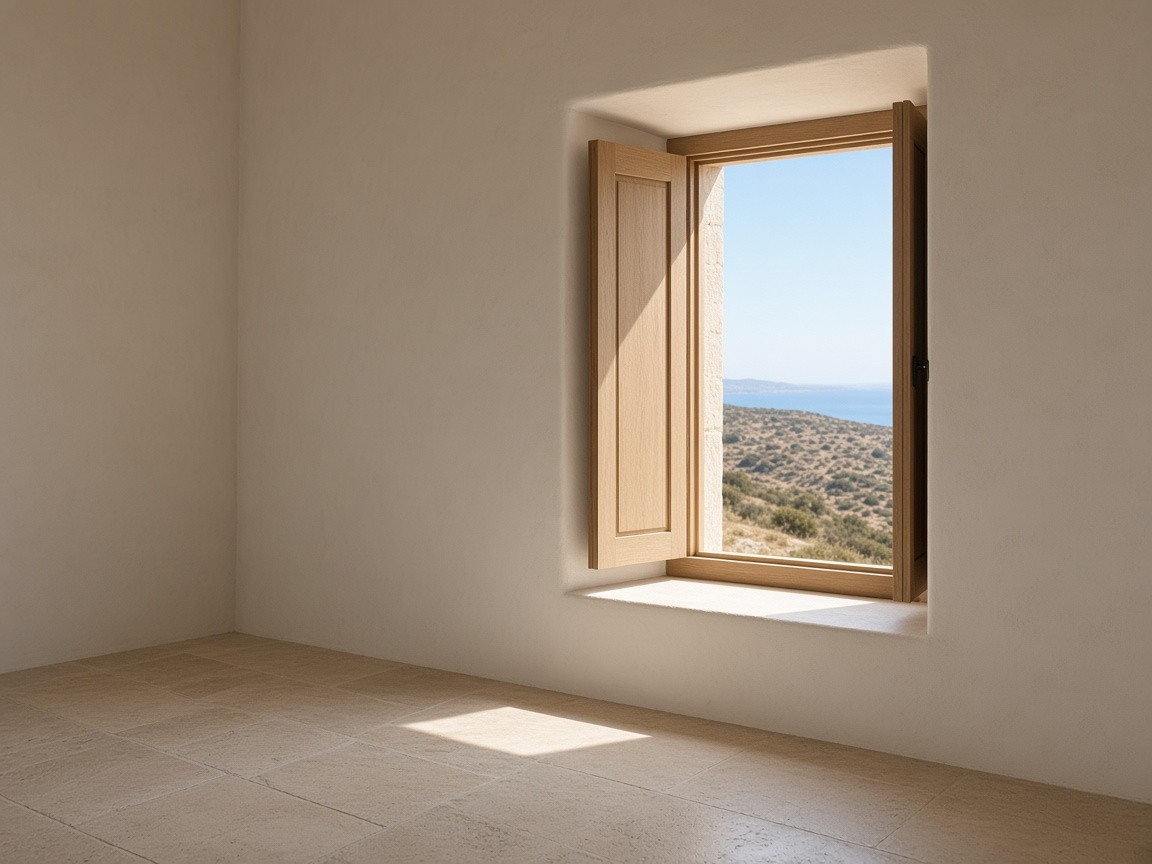
The evening sun comes back through the glass
Even when the roof and the wall have been built with care, most of the heat in Bodrum still comes in through the glass. The depth of the southern overhang is taken from the height of the glass beneath it. The same depth is not written onto every window. On the west the sun drops, and a horizontal overhang throws no useful shadow at that hour. The opening is made smaller. A vertical oak shutter is set in front of it, not to close off the view, but so the evening sun does not take back the work spent on the wall.
The glass is double glazed. In this climate double glazing is not an answer on its own. In a cold city the sun is wanted indoors. Here the pane is chosen so that less of the sun’s heat comes through. If the metal spacer at the edge is left as a thin bridge, salt air will show condensation there first. That line belongs to the insulation as well.
Moisture
Wet stone gives its heat to the room
Limestone carries salt and moisture in it. Once a cement plaster that cannot breathe is laid over it and a closed foam is stuck to the stone, the moisture has nowhere to go. The wall stays wet. Wet stone does not give its heat outward. It gives it to the room. Lime plaster is used inside, because it lets the stone dry. The insulation is built on the outside of the wall, not across the path by which the wall dries.
The same attention belongs on the roof. The waterproof sheet sits above the insulation. A plastic sheet laid under it without thought leaves the vapour in the timber and in the stone. Water is one layer, heat another. The space between them should not be a gap forgotten on site. That is where the vapour leaves.
Ground
The order fails at the edge of the slab
If winter water running off the slope is allowed into the court, it wets the edge of the slab first. A wet edge undoes, from below, the insulation that was carefully made above. The water is taken away from the house in a stone channel. Without that channel the order of the roof is not finished.
Under a room that is being cooled, the insulation runs between the soil and the slab without a pause. If it stops where the slab meets the wall, the heat from outside leaks into the room through that gap all summer. A void left beside a column is the same door. The house warms from there. That edge is looked at before the glass is blamed.
Thermal insulation sits outside the frame. The stone stands in front of a ventilated cavity. On the roof, the waterproof sheet is above the insulation.
House Doctor notes
What works
Air moves under the tiles, and the waterproof sheet stays above the insulation. The inside face of thick stone is left clear, so the stone that cools at night can hold the room until morning. On a frame the insulation runs outside and continues past the column. The glass admits less of the evening sun.
Watch
Coolness is not expected of a stone facing about twenty millimetres thick. A board fixed on the inside separates the room from the stone. An overhang measured for the south does not cut the evening sun once it has dropped. Closed foam stuck to the stone leaves moisture in the wall, and wet stone gives that heat indoors.
This site
This essay is for a Bodrum slope where August sticks to the roof and the rain waits until winter. A detail from Istanbul, where heating is the real concern, is not carried here. A north ridge that takes the meltem straight on does not use the same section. There the wind, and the hour of the sun, are different.
In the same place
Other coves in Bodrum
- Yalıkavak
- Türkbükü
- Gümüşlük
- Göltürkbükü
- Torba